

The abbreviated thesis of developmental psychology is that, as we mature, we pass through various developmental stages. These might be moral, meaning-making, or ontological stages, but we typically think of them as distinct phases: a person exists at one stage and then enters another, never to return.
This isn’t quite right, though. Development is more often uneven. A person might be in, say, Kegan’s Stage 4 in their professional life, but struggle with Stage 2 concerns in their romantic life, or vice-versa. Base developmental theories don’t adequately explain why this is, but I have a theory!
First, let’s consider how people move through stages. It typically happens in what feel like quantized jumps. It might not happen in a single moment, but over a period of days, weeks, or months, it’ll become clear that a person has transitioned from one stage to the next. From the inside, transitioning to a new stage often feels like waking up from a dream or looking up to see there’s a wider world out there.
But the transition to the new stage is at first unstable. For example, when an adolescent transitions from Kegan Stage 2 to 3, they don’t immediately drop all their Stage 2 behaviors. They might keep playing with favorite childhood toys or continue to struggle with being part of a team because they remain too focused on short-term goals. It often takes several years to fully leave Stage 2 behaviors behind, and Stage 2 behavior can come back in times of stress or grief.
Something similar happens if/when adults make the transition from Stage 3 to 4 and from 4 to 5. In the 3 to 4 transition, one common pattern is for a person to transition to Stage 4 in their professional life, but remain in Stage 3 in their personal life. This is often the case for busy professionals, like doctors and lawyers who are brilliant at work but have messy personal lives. The opposite is also common, especially among women, where a person becomes an adept socialite in their personal life, but struggles to function at work. Either way, the result is people who seem uncannily capable in some ways and totally dysfunctional in others.
The existence of such people was originally treated as evidence against developmental models. After all, if people could be between stages, then maybe stages aren’t real. But modern theories recognize that stages are models over a high-dimensional space of behaviors, and progression through stages over those dimensions don’t happen in lockstep. This is, to a first approximation, Ken Wilber’s big idea, and he’s written several books exploring it.
But Wilber’s point is largely static. At any point in time, a person might be unevenly developed, but this doesn’t say much about how they either get into that state or get out of it. And development does often proceed in an uneven way, even in a single dimension, because the idea of a “dimension” along which behavior can develop is also a model.
At the base level, there just are behaviors and the processes that generate them. When they change, such as when transitioning between stages along some dimension of development, they don’t necessarily change all at once. What happens usually looks more like a few, mostly inconsequential changes happening first. Then, enough of these small changes build up to unlock some bigger change that has effects noticeable enough that we call it a stage change. Later, a trail of habits that haven’t been retrained get updated, and it can take years to change them all in light of a stage transition.
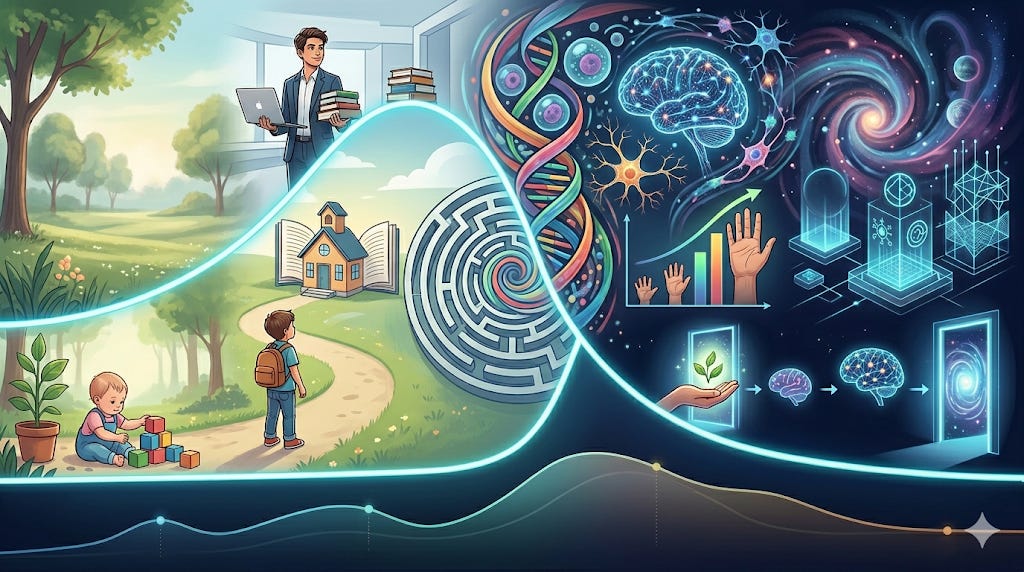
This pattern of development looks like having a leading and trailing edge of development. That is, there are always some behaviors which are operating from some furthest stage of development reached, there’s the main mass of the distribution somewhere behind it, and then there’s the long tail of the trailing edge.
The leading and trailing edge are where most of the action is. The leading edge is the place of growth into something more, like progressing from one stage to the next. The trailing edge is where maturation into what is already possible happens.
Growth at both the leading and trailing edge is needed to be psychologically healthy and avoid having a wide “spread” between developmental stages in different areas of life. Sadly, many people neglect one edge for the other, and it results in developmental stagnation and personal suffering.
Consider what happens if the leading edge is the only focus. A person will rush ahead as fast as they can to unlock insights and “level up”. They’ll feel like they’re unlocking the secrets of the universe, meanwhile, there’ll be a pile of unfolded laundry on their bed and a sink full of dirty dishes. They may in fact be having great realizations, but it’ll all be in their head, and fail to show up in how they actually live their life.
A focus on the trailing edge might seem better, but it lets a person get too comfortable. They’ll feel like they’ve done the work, eaten their shadow, and become whole, but if they stop there, they’ll be leaving out what they could become. They may be quite happy, but they’ll shrink away from doing the work to break away from their local maximum. More will be possible, but they won’t have tools to find their way to it.
Healthy development requires working with both edges. It requires insight and integration, growth and maturation. And if they do both, a person truly does look like they move through distinct developmental stages, because they keep pushing forward even as they’re cleaning up behind themselves.